
Amid US-China trade tensions and economic vulnerabilities, India must seize the 'China +1' opportunity, deepen reforms, secure FTAs, and globalise its firms for long-term growth, suggests Ajay Shah.

The BJP has strongly criticized the Congress party after youth wing workers staged a protest at the India AI Impact Summit, alleging the demonstration was orchestrated to tarnish India's global image.

Gold imports climbed 349.22 per cent to $12.07 billion in January, while silver imports rose 127 per cent to $2 billion.

New Delhi will substantially reduce tariffs on industrial and agricultural goods while continuing to protect sensitive sectors. Tariffs on some agricultural products that are not traditionally considered sensitive will be brought down to zero, while in the case of relatively sensitive items, duties will be reduced in a graded manner and quotas will be imposed.

With a confident new generation of innovators, India now has the scale and self-belief to shape its own digital destiny marked by creation, observes Ajay Kumar chairman, UPSC.
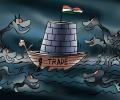
The growth in world trade is expected to slow down to one per cent in 2023, due to global uncertainties, according to a WTO forecast. The World Trade Organization (WTO) has also projected a growth of 3.5 per cent in global trade this year, as against the April estimate of 3 per cent. World trade is expected to lose momentum in the second half of 2022 and remain subdued in 2023, as multiple shocks weigh on the global economy, the multi-lateral body has said in a statement.

It may now be time to question the price India is paying for Israel's disregard of the serious undermining of India's energy security, asserts former foreign secretary Shyam Saran.
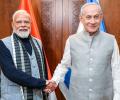
India and Israel share a deep historical bond, and Prime Minister Modi's visit to the Knesset marked a bold shift from past diplomatic hesitation to open strategic partnership.

The US has granted India permission to buy Russian oil already in transit to ease global supply pressures amidst the West Asia conflict. This decision comes after India agreed to halt sanctioned Russian oil purchases and substitute them with US oil.
Commerce Minister Piyush Goyal assures Parliament that India will take necessary steps to protect its national interests following the US announcement of tariffs on Indian goods. The government is assessing the implications and engaging with stakeholders.
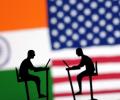

India and the US have settled the last trade dispute at the World Trade Organization (WTO) over poultry products, according to a joint statement released on Friday. With this, the two countries have mutually resolved all the seven pending trade disputes at the WTO. "The leaders lauded the settlement of the seventh and last outstanding WTO dispute between India and the United States.

'We are getting used to the constant alerts to take shelter, listening to sonic booms from jets flying above us, hearing news of neighbouring ports being targeted, and being the only ship in the terminal.'
For India, the challenge is to strike a balance between tactical necessity and economic priorities, point out Pravin Krishna and Monil Sharma.
The deal fell through over unresolved disagreements over contentious issues, mainly on agriculture and automotive sector tariffs.

The US has expressed concern over India's lack of transparency in its trade policy, as a result of which small and medium-sized enterprises have difficulties in investing and doing business in the country.

A meeting with Chinese President Xi Jinping on the sidelines of the SCO summit is being planned.

Developed economies like the US and EU are contemplating certain rules in relation to trade and environment which will have a significant implication for their border trade measures such as carbon taxation system for imports.

Trade talks resumed at the World Trade Organization headquarters at Geneva on Monday, 10 days after 30 ministers broke the impasse on Doha negotiations, aimed at reaching a global pact for opening $32 trillion international commerce.
India's tough diplomacy blocked a landmark world trade treaty late on Thursday, despite last-ditch talks to rescue what would have been the first global trade reform since the creation of the World Trade Organization 19 years ago.
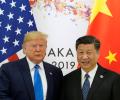
'If you compare the data from 2017 and 2023 of the US imports from the world and China, you will see that the US was a complete loser in the trade war, and China was a complete gainer.'
Political rhetoric ahead of Presidential elections in US is denting trade ties.
The US wants India to recognise internationally accredited labs, harmonise labelling requirements and the validity period of test reports and certification with global practices, and eliminate retesting requirements.
Specific difficulties and last-minute backtracking now can only be overcome by trade ministers at a biennial meeting on Dec 3-6.

The initiative for the consultations among the select ministers was taken by Australian Trade Minister Simon Crean.

In a culture where children take up the profession of their father, her becoming a politician was seen as natural and acceptable.
Trade ministers of key WTO member countries, including India would meet on the sidelines of the Organisation for Economic Cooperation and Development meeting in Paris in the last week of May.
'The government is actively engaging with EU to ensure that concerns of Indian companies and hard-to-abate sectors are adequately addressed under CBAM'

Japan is expected to increase its investment target in India from the earlier 5 trillion yen ($34 billion) to almost 10 trillion yen.
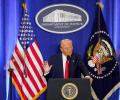
Unless something changes, Mr Trump is a huge threat right now, which is perhaps not being recognised fully, cautions Debashis Basu.
Take the Rediff Biz Quiz and find out how much you know about the World Trade Organization.

Sanctioning Russian oil would have led to a sharp surge in oil prices to above $80 per barrel levels, which would impact pump prices in the US ahead of midterm elections next year.

The BRICS nations on Friday underlined the need for using local currencies in international trade and financial transactions besides committing themselves to supporting rule-based open and transparent global trade. A joint statement issued at the end of the meeting of the BRICS Ministers of Foreign Affairs and International Relations, also pressed for a robust Global Financial Safety Net with a quota-based and adequately resourced International Monetary Fund (IMF) at its centre. It further said the process of IMF governance reform under the 16th General Review of Quotas, including a new quota formula as a guide, should be completed by December 15, 2023.

India's new national accounts will leverage new data sources and surveys to enhance the measurement of the country's informal economy, and introduce double deflation methods across sectors, replacing the current system that relies on a single deflation mechanism in Gross Domestic Product (GDP) calculations.
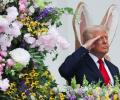
Trump may temper his approach from time to time, but to think that he will change his basic philosophy is delusional, asserts T T Ram Mohan.
Trade ministers of four key World Trade Organization members -- India, Brazil, the US and EU -- will make another attempt in Brussels later this week to bridge the gaps on the contentious issues of farm subsidies and market access.

The BRICS nations have expressed concern over the proliferation of trade-restrictive actions in the form of 'indiscriminate rising' of tariffs, particularly measures used as a means of 'coercion', cautioning that such practices risk marginalising the Global South countries.
China threatens to bring its opposition to India's toy import ban to the WTO, while India seems poised to restrict other Chinese products
